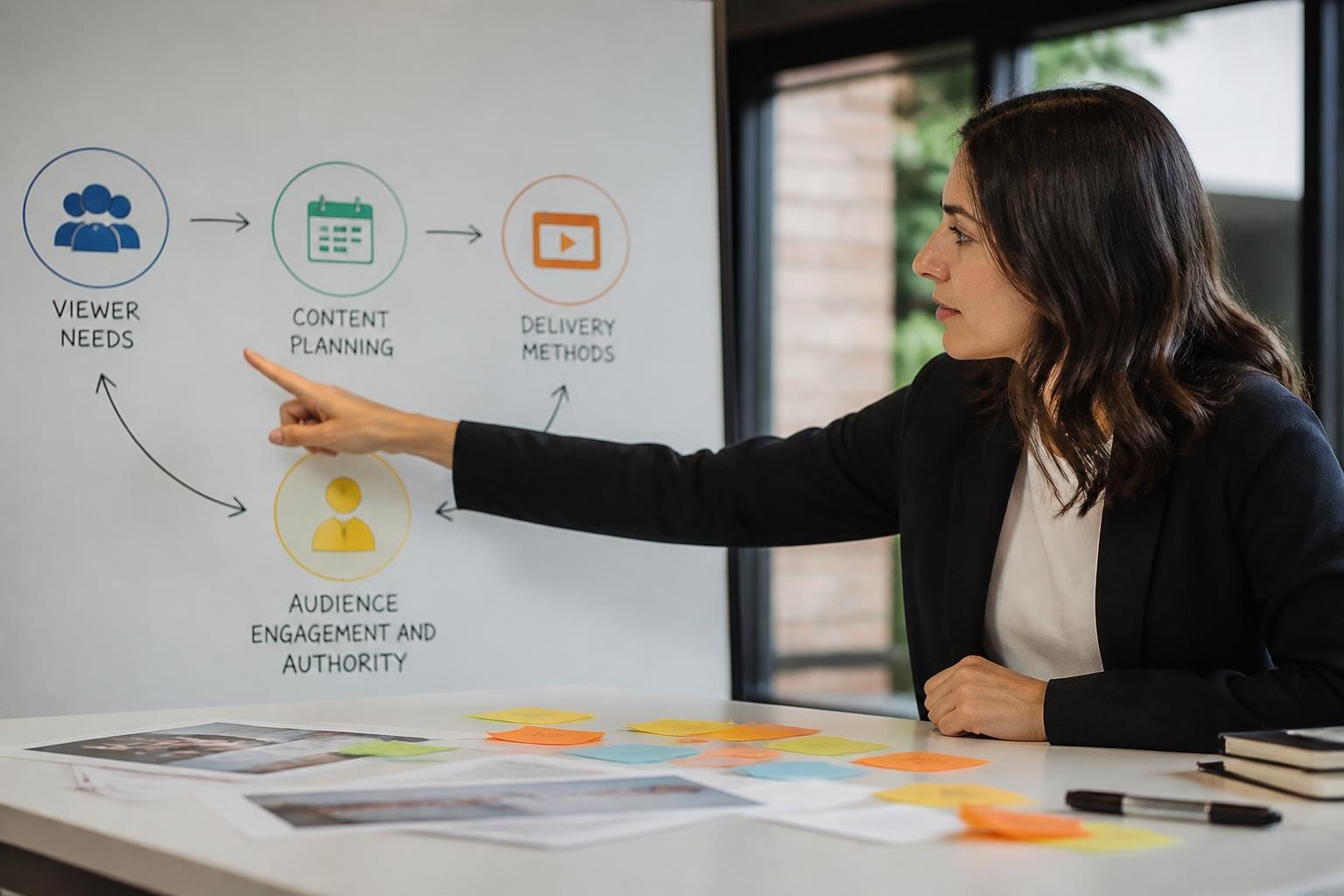
Landing a television interview isn't about luck or connections. It's about understanding what producers need and delivering a hook they can't ignore. Every day, segment producers scan hundreds of pitches, searching for stories that fit their format, serve their audience, and make their job easier. The difference between getting booked and getting ignored comes down to one thing: your hook. When CEOs, authors, and experts master tv segment hooks that get booked, they unlock a credibility-building channel that elevates their authority faster than any other medium.
What Makes a Hook "Bookable" in Producer Language
Producers operate under relentless deadlines and audience expectations. They're not looking for the most famous guest or the biggest company. They're hunting for stories that solve a clear problem, visualize well on screen, and deliver value to viewers in three to five minutes.
A bookable hook answers three producer questions before they finish reading your subject line: What will the audience see? What will they learn? Why now? These questions align directly with how newsrooms structure segments. Understanding broadcast production fundamentals gives you insight into how producers think about A-blocks, B-blocks, and segment flow.

The Visual Requirement Every Pitch Must Meet
Television is a visual medium. If your segment can't be demonstrated, illustrated, or shown on camera, it won't get booked. Period.
Producers need to imagine the segment before they pitch it to their executive producer. That means your hook must paint a clear picture:
- Demonstrations: Can you show the method, technique, or product in action?
- Before-and-after moments: Does your story include a transformation viewers can witness?
- Props and examples: What physical elements make your expertise tangible?
- On-screen graphics: Does your data or framework translate into simple visuals?
The most successful tv segment hooks that get booked include specific visual elements in the pitch itself. Instead of "I'll discuss productivity strategies," try "I'll demonstrate the three-minute morning routine that doubled my clients' output, using a whiteboard timer and task cards viewers can recreate at home." One describes an idea; the other lets the producer see the segment.
Research on how broadcast journalists craft their presentations reveals that visual, people-centric hooks align with what producers value most: content that connects with viewers immediately and emotionally.
The Anatomy of Hooks That Producers Forward
When a producer reads your pitch and immediately forwards it to their executive producer, you've nailed the formula. That forwarding moment is your goal.
Winning hooks share a consistent structure:
| Element | Purpose | Example |
|---|---|---|
| Timely angle | Connects to current events, seasons, or trends | "With Q4 hiring season approaching…" |
| Specific outcome | Promises a concrete viewer benefit | "…three questions that identify A-players in 10 minutes" |
| Visual proof | Describes what the camera will capture | "…I'll demonstrate the interview technique live with your host" |
| Credential snapshot | Establishes why you're the expert | "…used by 200+ companies including [recognizable name]" |
Numbers, Lists, and Frameworks Producers Love
Producers build rundowns around time blocks. A segment hook that promises "five ways to…" or "the three-step method for…" gives them a built-in structure. They know exactly how the segment will unfold, how many questions the host will ask, and where to place commercial breaks.
Frameworks make you bookable because they make the producer's job easier:
- Numbered lists create natural segment breaks
- Step-by-step methods give hosts clear questions to ask
- Diagnostic tools (quizzes, assessments) add interactivity
- Comparison charts translate into on-screen graphics
When crafting your hook, build in these structural elements. "The Five-Minute Financial Audit Every Small Business Owner Should Run Monthly" beats "Small Business Financial Tips" every time because the producer can already see the segment: five questions, five answers, five on-screen tips. For experts working on presentation skills, this structured approach also improves on-camera performance.
Timeliness: The Urgency Factor That Moves Pitches to the Top
Every producer manages a pipeline of "evergreen" and "timely" content. Evergreen segments (health, productivity, relationships) compete with hundreds of other pitches. Timely segments tied to breaking news, seasonal moments, or cultural conversations jump the queue.
The timeliness test is simple: Why does this story matter this week?
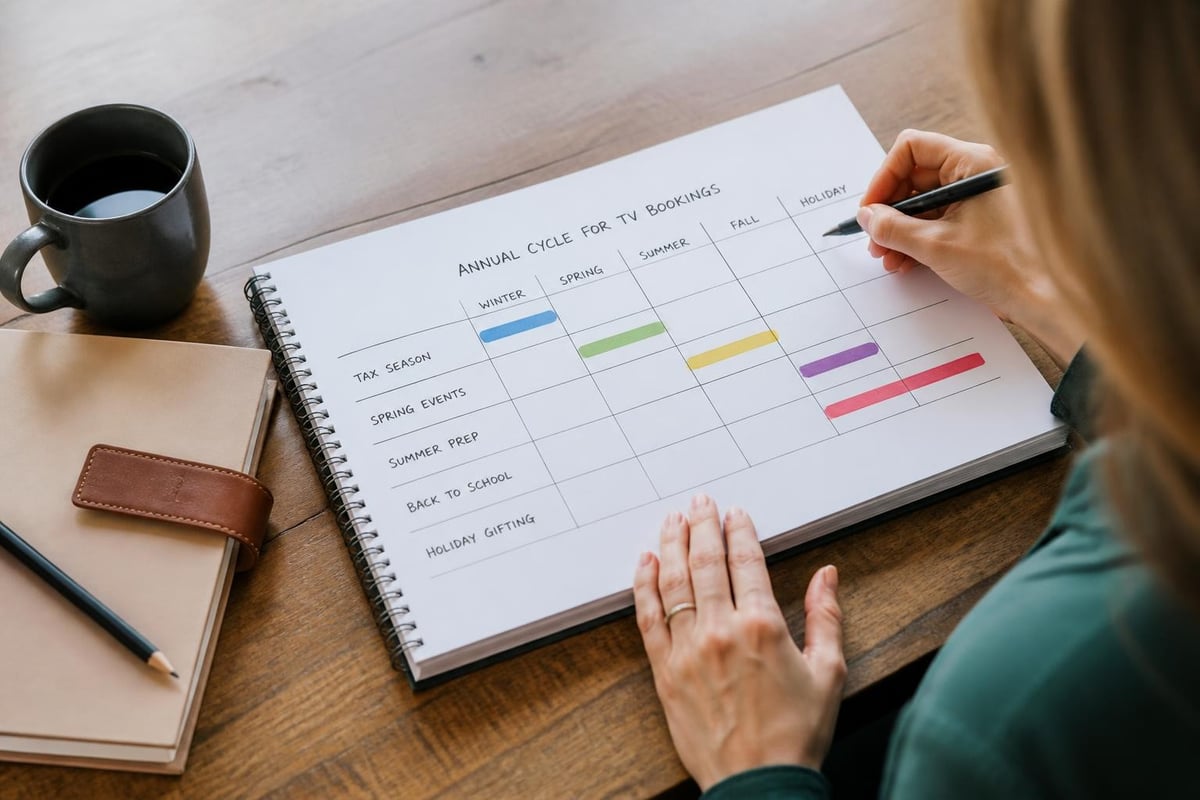
Seasonal hooks dominate local morning shows and daytime television. Tax season, back-to-school, holiday stress, New Year goals, summer safety-these calendar moments create predictable booking windows. Smart experts build their pitch calendar around these cycles six to eight weeks in advance.
Current events create urgency but require speed. When major news breaks, producers need expert commentary within hours. If your expertise connects to trending topics, maintain a "breaking news" pitch template you can customize and send immediately.
Riding Trends Without Chasing Fads
Industry trends in journalism platforms show that producers increasingly value segments that work across broadcast and digital distribution. Your hook should anticipate how the segment will travel on social media, YouTube clips, and streaming platforms.
Trend-based tv segment hooks that get booked connect your expertise to what audiences are already discussing:
- Search data: "Google searches for 'quiet quitting' jumped 300% this month…"
- Social conversations: "TikTok users are sharing [specific challenge], but experts warn…"
- Industry reports: "New data shows [statistic], and here's what it means for [audience]…"
The key is adding original insight, not just repeating the trend. Producers want experts who can explain why the trend matters and what viewers should do about it.
Crafting Your Segment Title and Teaser
Producers think in segment titles and teasers-the on-screen text and host introduction that hook viewers. When you pitch, include a suggested segment title and 15-second teaser in your email.
Your segment title should be:
- Specific and benefit-driven: "Five Warning Signs Your Business Partner Is Stealing"
- Action-oriented: "Stop Losing Talent: The Interview Question Top CEOs Always Ask"
- Conversational: Write how a host would say it, not how you'd write it in an article
The teaser is the 10- to 15-second script the host reads to introduce the segment. Write it in second person, directly addressing the viewer:
"Are you making these three costly mistakes when hiring? Our next guest helps CEOs build million-dollar teams, and she says most leaders overlook a critical red flag in the first interview. Stay with us."
When you hand producers ready-to-use language, you make booking easier. They can copy your title and teaser directly into their rundown. Practical guidance on pitching daytime television emphasizes this same principle: paint the segment for them.
Understanding Different Show Formats and Their Hook Preferences
Morning shows, daytime talk programs, news segments, and specialty shows each have distinct formats and audience expectations. TV segment hooks that get booked match the show's style.
Local Morning Shows (5 AM – 9 AM)
Local morning shows prioritize:
- Quick, actionable tips viewers can use that day
- Visual demonstrations and hands-on segments
- Local angles and community connections
- Upbeat, energetic delivery
Hook example: "Three items already in your kitchen that deep-clean grout in five minutes-perfect for spring cleaning season."
Examples of local morning show pitches demonstrate how to translate expertise into format-appropriate hooks.
National Daytime Talk (9 AM – 4 PM)
National daytime shows seek:
- Emotionally resonant stories with personal transformation
- Expert solutions to common problems
- Celebrity connections or high-profile case studies
- Longer-form storytelling (4-7 minutes)
Hook example: "The body language mistake that cost my client a $2M deal-and the two-second fix that closed the next one."
News Segments (Early Morning, Midday, Evening)
News segments require:
- Hard news angles or data-driven stories
- Quick hits (90 seconds to 3 minutes)
- Credentialed experts with institutional authority
- Connection to current events
Hook example: "New employment data shows remote workers earn 15% less-what the numbers miss and how to negotiate fairly."
The Credibility Stack: What Producers Check Before Booking
Producers vet every potential guest before booking. Your credibility determines whether your hook moves forward. The "credibility stack" includes:
| Credibility Element | What Producers Look For |
|---|---|
| Professional credentials | Relevant degrees, certifications, licenses |
| Published work | Books, articles in recognized outlets |
| Previous media | TV clips, podcast appearances, speaking reels |
| Client results | Case studies, testimonials, measurable outcomes |
| Social proof | Follower count, engagement, thought leadership |
Established authorities often maintain a client proof portfolio that consolidates these elements for producers. Your one-sheet or media kit should make credibility instantly verifiable.
The Demo Reel That Opens Doors
If you've never been on TV, producers face higher risk booking you. They don't know if you'll freeze on camera, ramble, or deliver flat energy. A demo reel solves this problem.
Your demo reel should be 60-90 seconds and show:
- On-camera presence: Natural, confident delivery
- Sound bites: Quotable, concise answers
- Energy: Enthusiasm and engagement
- Variety: Different settings (studio, remote, live)
If you don't have TV clips yet, create a self-produced reel. Record yourself answering the five most common questions in your field. Use professional lighting and audio. Treat it like a real interview. This investment in building confidence on camera pays dividends when producers review your pitch.

Writing the Pitch Email That Gets Opened and Answered
Your hook lives or dies in the subject line and first two sentences of your email. Producers receive 50-200 pitches daily. You have three seconds to earn their attention.
Subject line formula:
[Timely angle] + [Specific benefit] + [Your credential]
Examples:
- "Holiday Hiring Rush: 3-Minute Interview Method (Used by 500+ Companies)"
- "Tax Season Mistakes Costing Small Businesses $10K+ (CPA + Author)"
- "Back-to-School Anxiety Spike: Proven 5-Step Parent Protocol (Child Psychologist)"
Email body structure:
- Opening hook (1 sentence): State the timely problem or trend
- Your solution (2-3 sentences): Explain your unique angle and what viewers will learn
- Visual description (1-2 sentences): Paint the segment-what will the camera show?
- Credibility (1 sentence): Your most relevant credential or result
- Logistics (1 sentence): Your availability and flexibility
- Call to action (1 sentence): Invite them to reply or schedule a call
Keep the total email under 150 words. Attach your one-sheet and include a link to your demo reel.
Resources from organizations like PRSA showcase award-winning media campaigns that demonstrate the power of targeted, well-crafted pitches.
Packaging Your Expertise for Maximum Bookability
Not all expertise translates directly to television. The transformation from "what you know" to "what makes good TV" requires strategic packaging.
Breaking Down Complex Topics Into Micro-Segments
If you're a financial planner, "comprehensive retirement planning" is too broad for a four-minute segment. Break it into micro-topics:
- "The One Retirement Account Most 40-Year-Olds Ignore"
- "Three Social Security Mistakes That Cost $100K+"
- "Why Your 401(k) Allocation Is Probably Wrong (And the 10-Minute Fix)"
Each micro-topic becomes a separate pitch opportunity. You build a content library of tv segment hooks that get booked by slicing your expertise into viewer-sized pieces.
Turning Client Stories Into Segment Narratives
Producers love before-and-after transformations. Your client case studies are pre-built segment narratives:
- Before: The problem your client faced (relatable to viewers)
- Intervention: Your method, framework, or solution (the teachable moment)
- After: The measurable result (proof it works)
Frame your hook around this arc: "How One CEO Cut Meeting Time by 60% in 30 Days (And Your Team Can Too)."
When developing your approach, consider how statistics enhance storytelling without overwhelming viewers.
Building Relationships With Segment Producers
TV booking is a relationship business. One-off pitches rarely work. Consistent, valuable outreach builds producer relationships that lead to repeat bookings.
Start with local stations. Research the segment producers at your local network affiliates (NBC, ABC, CBS, FOX). Follow them on social media, engage with their posts, and learn what segments they produce. When you pitch, reference specific recent segments: "I loved your piece on small business marketing last Tuesday. I have a related angle on email automation that would resonate with your audience."
Provide value first. Before you pitch yourself, send producers useful information:
- Trend alerts in your industry
- Data they can use for future segments
- Expert sources for breaking news (even if it's not you)
- Compliments on segments you genuinely enjoyed
This positions you as a resource, not just someone seeking airtime.
Follow up strategically. If a producer doesn't respond to your first pitch, wait one week and send a brief follow-up with a new angle or timely update. If you still get no response, move that pitch to your "evergreen" file and try a completely different hook in 30 days. Persistence works; pestering doesn't.
Adapting to how newsrooms are evolving helps you align your pitches with their digital and broadcast needs.
Common Hook Mistakes That Kill Your Pitch
Even experienced experts make preventable mistakes that doom their pitches. Avoid these credibility killers:
Vague value propositions: "I'll share leadership tips" tells the producer nothing. "I'll demonstrate the three-question framework Fortune 500 CEOs use to identify future executives" tells them everything.
Industry jargon: Producers aren't experts in your field. If your pitch requires specialized knowledge to understand, it won't get booked. Translate technical concepts into everyday language.
Self-promotion disguised as education: Producers spot promotional segments immediately. Your hook must deliver genuine viewer value, not a commercial for your services. The segment should work even if viewers never learn your company name. Understanding publicity fundamentals helps you maintain this balance.
Ignoring show format: Pitching a serious financial segment to a light lifestyle show guarantees rejection. Research each show's tone, pace, and typical content before pitching.
No clear ask: End every pitch email with a specific call to action-"Are you interested in booking this for next week?" or "I'd love to send you a detailed segment outline." Don't leave producers guessing what you want.
Scaling Your Booking Success Across Multiple Markets
Once you crack the code on tv segment hooks that get booked, scale your success by adapting proven hooks across markets and shows.
Create a master hook library. Document every segment idea that works. Track which angles get the best response rates, which visuals producers love, and which formats book fastest. Build templates for seasonal pitches (tax time, back-to-school, holidays) that you update and reuse annually.
Adapt hooks for regional audiences. A segment on "Surviving Summer Heat for Seniors" plays differently in Phoenix than in Seattle. Customize your pitch to reflect local concerns, climate, and culture. Local producers prioritize stories with clear local relevance.
Leverage one booking for more bookings. After a successful segment, ask the producer for a testimonial you can include in future pitches. Create a video clip from the segment and add it to your demo reel. Reference the appearance in your bio: "As seen on [NBC/ABC/CBS affiliate]."
Bundle complementary hooks. Instead of pitching one idea, offer producers a choice: "I have three segment concepts that fit your show-would you like to hear about workplace productivity, team communication, or leadership hiring?" This increases your chances of finding something that fits their current needs.
Approaches covered in Forbes guidance on TV integrations can inform how you position multiple hooks to producers.
Measuring What Works and Iterating Your Approach
Track your pitch success rate and identify patterns. Create a simple spreadsheet with columns for:
- Date sent
- Producer/show
- Hook topic
- Response (yes/no/maybe)
- Booking date (if applicable)
- Notes
After 20-30 pitches, you'll see patterns. Which hooks generate the most replies? Which shows respond best? What time of year works best for your topics? Use this data to refine your approach.
A/B test your subject lines. Send the same pitch to similar shows with different subject lines. Track which version gets more opens and responses. Over time, you'll develop a formula that works for your niche.
Request feedback from producers. When a pitch gets rejected, politely ask, "Would you be open to sharing what didn't fit? I'd love to tailor future pitches to your needs." Many producers appreciate the professionalism and will give you valuable insights.
Your Path to Becoming a Go-To Media Expert
Mastering tv segment hooks that get booked transforms you from someone who wants media coverage into someone producers seek out. The shift from pitching to being pitched happens when you consistently deliver value, understand the producer's world, and make their job easier.
Every segment you book builds your authority, expands your visibility, and creates assets (video clips, credibility markers) that accelerate future bookings. The experts who dominate television aren't necessarily the smartest or most experienced-they're the ones who understand what makes good TV and how to package their expertise accordingly. When you treat every pitch as an opportunity to serve the audience and support the producer, bookings follow naturally.
TV segment hooks that get booked follow a proven formula: timely angles, visual demonstrations, specific viewer benefits, and credibility that producers can verify. When you master this framework, you transform from expert to authority. Mitch Carson specializes in helping CEOs, authors, and experts develop producer-ready positioning and secure guaranteed TV placements through the BookedForTV™ system. If you're ready to build market-leading authority through strategic media visibility, connect with Mitch Carson to learn how the guaranteed placement approach can elevate your expert positioning.