
The difference between a forgettable television appearance and one that positions you as the definitive authority in your field often comes down to structure. CEOs and authors who command attention on camera understand that effective messaging follows a proven framework. The tv message formula represents a strategic approach to crafting compelling narratives that resonate with producers, captivate audiences, and convert viewers into premium clients. This formula transcends platform, whether you're appearing on broadcast television, streaming content, or digital video, yet remains rooted in principles that have driven successful television communication for decades.
Understanding the Core Framework
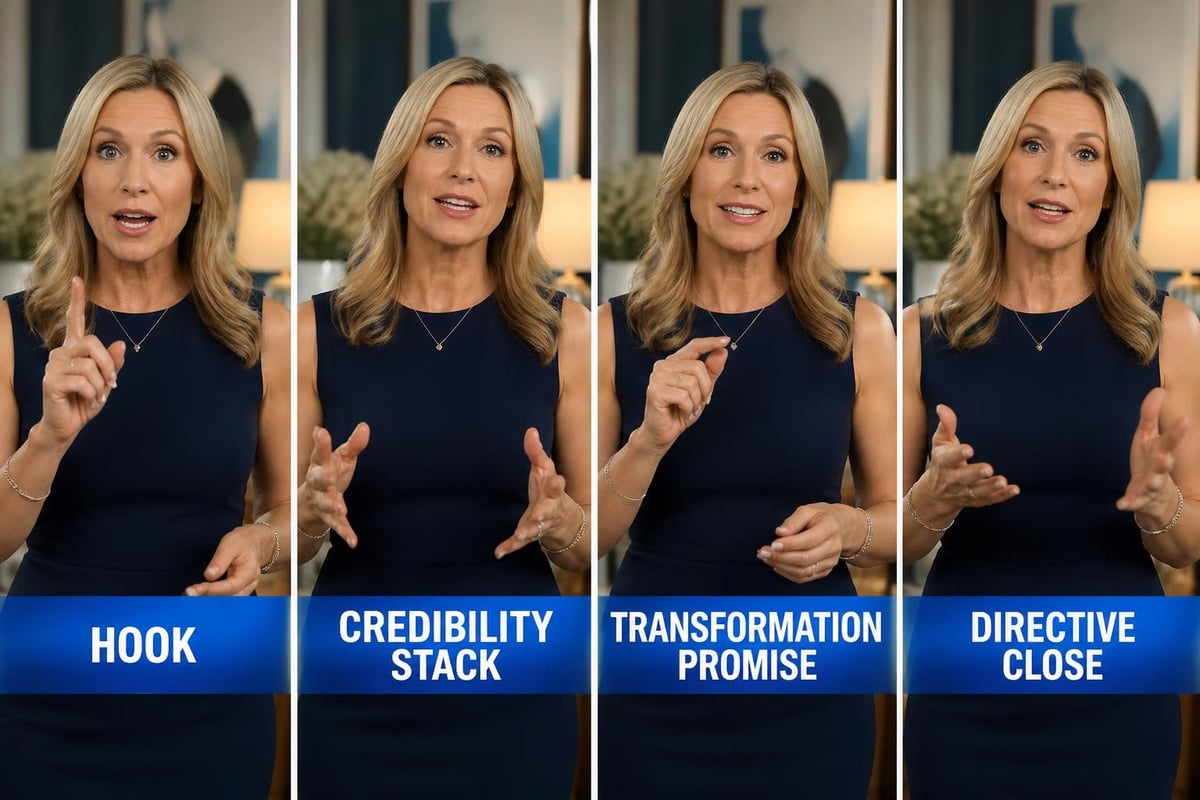
The tv message formula consists of four essential components that work together to create memorable, persuasive content. Each element serves a specific psychological purpose and builds upon the previous one to guide your audience through a carefully designed journey.
The foundational structure includes:
- The Hook: A compelling opening that immediately establishes relevance and captures attention within the first seven seconds
- The Credibility Stack: Strategic positioning of authority markers that justify why viewers should listen
- The Transformation Promise: A clear articulation of the change, insight, or value the viewer will receive
- The Directive Close: A specific call to action that moves the audience from passive viewing to active engagement
Research from the Journal of Advertising Research demonstrates that emotional flow and dramatic structure directly predict purchase intent and message impact. The most effective messages create an emotional arc that peaks at strategic moments, reinforcing key points through controlled tension and release.
Why Traditional Pitching Fails on Camera
Many experts approach television with the same messaging they use for written content or stage presentations. This fundamental misalignment explains why qualified authorities often fail to convert media appearances into business outcomes.
Television operates on compressed timelines. Producers allocate segments in minutes, not hours. Viewers make retention decisions in seconds, not paragraphs. The tv message formula accounts for these constraints by front-loading value and eliminating anything that doesn't directly serve audience transformation or credibility building.
Consider the typical expert introduction: credentials, background, methodology, then value. Television reverses this entirely. Value comes first. The hook delivers an immediate insight or revelation that creates information gap tension. Only after establishing relevance do you layer in credibility markers, and these must be woven naturally into the narrative rather than listed.
Crafting Hooks That Command Attention
The opening seven seconds of any television message determine whether viewers lean in or tune out. Effective hooks exploit one of three psychological triggers: contradiction, specificity, or consequence.
Contradiction hooks challenge existing beliefs or common practices. "Everything you know about customer retention is costing you revenue" creates immediate cognitive dissonance that demands resolution. The brain cannot ignore information that conflicts with established patterns.
Specificity hooks use precise numbers or unique frameworks to signal insider knowledge. "The 17-second positioning window that separates industry leaders from everyone else" suggests concrete, actionable intelligence rather than generic advice.
Consequence hooks establish immediate stakes. "This regulatory change affects every business over $2 million in revenue within 90 days" creates urgency and relevance simultaneously.
According to Google’s AI for Video Advertising best practices, the first few seconds of video content must establish brand, communicate value, and drive emotional connection. Their research shows that front-loading key messaging elements significantly improves both recall and conversion metrics.
The Credibility Stack Strategy
Once you've captured attention, the tv message formula requires strategic credibility placement. This isn't about listing credentials; it's about weaving authority markers into narrative moments that reinforce your central message.
| Credibility Type | Implementation | Psychological Impact |
|---|---|---|
| Results-based | "Our clients averaged 340% ROI in 18 months" | Demonstrates proven methodology |
| Recognition-based | "Featured in Harvard Business Review's analysis of…" | Leverages institutional authority |
| Specificity-based | "After analyzing 2,847 customer interviews…" | Signals depth of research and expertise |
| Contrarian-based | "While most experts recommend X, we discovered Y" | Positions as innovative thought leader |
The credibility stack works because it provides proof points exactly when the viewer's skepticism peaks. After a bold hook, audiences instinctively question whether the speaker can deliver on the promise. Strategic credibility markers answer this objection before it forms consciously.
For professionals working to build confidence in their public speaking, understanding that credibility serves the message rather than the ego fundamentally shifts on-camera performance. You're not proving your worth; you're providing evidence that supports the viewer's decision to keep listening.
Structuring the Transformation Promise
The core of the tv message formula centers on articulation of specific, achievable transformation. Generic promises ("improve your business," "increase revenue," "become more successful") fail because they lack the specificity that creates mental imagery and emotional investment.
Effective transformation promises follow a three-part structure:
- Current State Identification: Precisely describe the pain, frustration, or limitation the viewer currently experiences
- Mechanism Revelation: Explain the specific insight, framework, or approach that bridges current state to desired state
- Future State Visualization: Paint a concrete picture of measurable outcomes after implementing the solution
Research from Harvard Business School on television advertising effectiveness demonstrates that targeted messaging with clear value propositions generates significantly higher response rates than broad, generic content. The specificity of your transformation promise directly correlates with viewer action.
Frameworks for Transformation Articulation
The most compelling transformation promises use frameworks that create mental scaffolding. These structured approaches help viewers understand complex concepts quickly and remember them long after the segment ends.
The Before-Insight-After Framework works particularly well for thought leadership positioning. "Most CEOs struggle with client acquisition because they position on features rather than transformation. When you shift to outcome-based positioning, you attract clients who pay premium fees because they're buying results, not hours."
The Problem-Agitate-Solve Framework intensifies emotional investment before offering resolution. "You're losing qualified prospects in the first meeting. This happens because traditional discovery questions trigger sales resistance. Our diagnostic framework eliminates this friction by restructuring the entire conversation architecture."
The Challenge-Choice-Consequence Framework empowers viewer agency while creating urgency. "You face a positioning decision: compete on price in a commoditized market, or establish authority that commands premium positioning. Companies that delay this choice typically lose 18-24 months of potential revenue growth."

Understanding the importance of public speaking in authority building means recognizing that transformation promises must be calibrated to the viewer's readiness level. Television audiences range from completely unaware to actively seeking solutions. The tv message formula accounts for this by focusing on the "problem aware, solution unaware" segment, which represents the largest opportunity for expert positioning.
The Directive Close Methodology
The final component of the tv message formula determines whether your message generates business outcomes or simply builds awareness. Many experts waste powerful television appearances with weak, ambiguous closes that leave viewers uncertain about next steps.
Directive closes must accomplish three objectives:
- Create a specific, low-friction action the viewer can take immediately
- Reinforce the transformation promise through the action itself
- Establish a logical next step in the authority-building journey
The most effective television closes avoid direct sales pitches in favor of value-first offers. "Visit [domain] to access our 7-minute Authority Diagnostic that reveals your current positioning gaps" provides immediate value while initiating the relationship. This approach aligns with producer expectations (educational content over promotional) while achieving business objectives (list building and qualification).
Contrast this with weak closes that dilute impact: "Learn more at our website," "Follow us on social media," or "Contact us for more information." These generic directives create decision paralysis and fail to differentiate your offering from countless other experts making similar requests.
Measurement and Refinement
The tv message formula requires continuous optimization based on viewer response data. Platforms ranging from broadcast television to connected TV (CTV) now provide unprecedented measurement capabilities that allow message refinement.
According to the IAB’s 2025 Digital Video Ad Spend report, advertisers are prioritizing creative quality and message effectiveness metrics over reach alone. This shift toward outcomes-based measurement means that structured messaging frameworks like the tv message formula can be validated through data rather than intuition.
Key performance indicators for message effectiveness include:
| Metric | What It Reveals | Optimization Opportunity |
|---|---|---|
| Completion Rate | Hook and relevance strength | Refine opening seven seconds |
| Click-Through Rate | Call-to-action clarity and appeal | Test different directive closes |
| Conversion Rate | Transformation promise alignment | Adjust specificity and credibility markers |
| Share Rate | Emotional resonance and value perception | Enhance frameworks and insights |
The IAB’s analysis of creative management in CTV reveals that consistent message delivery across platforms requires systematic creative frameworks. The tv message formula provides this consistency while allowing tactical adjustments based on segment length, audience demographics, and platform characteristics.
Adapting the Formula Across Formats
While the core structure of the tv message formula remains constant, implementation varies based on segment length and interview format. A three-minute segment requires different pacing than a 30-second promotional spot, yet both benefit from the same foundational framework.
Short-Form Implementation (30-90 seconds)
Short segments demand extreme discipline. Every word must serve the formula. The hook becomes a single sentence. The credibility stack condenses to one power credential. The transformation promise focuses on a single, specific outcome. The directive close provides one clear action.
"Most CEOs lose premium clients in the first conversation. After analyzing 3,000 sales calls, we discovered the exact moment prospects disengage. Our clients now close high-ticket deals at 73% rates by restructuring this critical window. Access our breakdown at [domain]/diagnostic."
This 32-second message delivers all four formula components without wasted language. Notice how the credibility marker ("analyzing 3,000 sales calls") integrates into the narrative flow rather than appearing as a separate credential statement.
Medium-Form Implementation (3-8 minutes)
Standard television interview segments allow for expanded storytelling while maintaining formula structure. The hook can develop through a brief narrative example. The credibility stack weaves multiple authority markers throughout the conversation. The transformation promise explores mechanism in greater depth. The directive close might include a secondary action for viewers at different readiness stages.
This format benefits from strategic repetition. The core message gets stated, explained, illustrated, and restated. Research from the IPA Effectiveness Databank demonstrates that message consistency and creative strategy contribute significantly to long-term brand and sales effects. Repetition isn't redundancy when each iteration adds dimension to the central idea.

Long-Form Implementation (20+ minutes)
Podcast interviews, documentary features, and extended television formats allow the tv message formula to expand into comprehensive thought leadership positioning. The hook evolves into an origin story that establishes both personal credibility and problem significance. The credibility stack becomes an integrated narrative of professional evolution and breakthrough discoveries. The transformation promise develops through case studies, data analysis, and framework explanation. The directive close offers multiple engagement pathways calibrated to different audience segments.
Even in long-form content, the formula prevents common pitfalls: meandering narratives that bury key insights, credential dumps that bore viewers, vague value propositions that fail to inspire action. The structure ensures that regardless of runtime, your message builds toward clear outcomes.
Integration With Authority Strategy
The tv message formula exists within a broader authority-building ecosystem. Television appearances serve as leverage points that amplify credibility, generate content assets, and create social proof that supports premium positioning.
For CEOs and authors working to establish presentation skills that command attention, the formula provides a reliable structure that reduces performance anxiety. When you know exactly what each segment of your message must accomplish, preparation becomes systematic rather than overwhelming.
The formula integrates with multiple authority channels:
- Book publishing: Chapter structures that mirror the formula create readable, persuasive content
- Podcast interviews: Consistent messaging across appearances builds recognition and recall
- Speaking engagements: Stage presentations benefit from the same hook-credibility-transformation-directive structure
- Written content: Articles and social posts adapted from the formula maintain message consistency
This integration explains why certain experts dominate their categories while others with equal expertise remain unknown. Consistent application of a proven message structure creates compound credibility effects. Each appearance reinforces previous ones. Audiences begin to associate specific frameworks and insights with your personal brand.
Understanding how to overcome the fear that public speaking is scary often requires recognizing that preparation excellence eliminates most performance anxiety. The tv message formula provides this preparation framework. You're not hoping inspiration strikes during the interview; you're executing a tested structure.
Producer Psychology and Message Selection
Television producers serve as gatekeepers who determine which experts receive airtime and which messages reach audiences. Understanding producer psychology reveals why the tv message formula aligns with selection criteria.
Producers prioritize several key factors when evaluating expert segments:
- Audience Value: Does this message provide actionable insights viewers can immediately apply?
- Credibility Verification: Can this expert substantiate claims with data, results, or credentials?
- Production Efficiency: Will this expert deliver concise, quotable content that fits segment constraints?
- Controversy Avoidance: Does the message inform without creating legal or ethical complications?
The tv message formula addresses each concern. The transformation promise ensures audience value. The credibility stack provides verification. The structured approach guarantees production efficiency. The focus on frameworks and insights rather than personal attacks or unsubstantiated claims minimizes risk.
Professionals who consistently secure media placements understand that producers are buying solutions to their programming challenges, not granting favors to experts. Your message formula should solve the producer's problem (filling airtime with valuable content that keeps viewers engaged) while simultaneously achieving your objectives (authority positioning that attracts premium clients).
Common Formula Violations and Fixes
Even experts familiar with the tv message formula often sabotage effectiveness through predictable violations. Recognizing these patterns allows rapid correction.
| Violation | Impact | Correction |
|---|---|---|
| Leading with credentials instead of value | Viewer disengagement in first 15 seconds | Restructure to hook-first, credentials-second sequence |
| Generic transformation promises | Fails to differentiate from competitors | Add specific numbers, timelines, and mechanisms |
| Multiple competing messages | Dilutes recall and confuses call-to-action | Focus entire segment on single transformation |
| Weak or absent directive close | Loses conversion opportunity | Create specific, low-friction next step |
| Technical jargon without translation | Excludes broad audience | Explain concepts using analogy and plain language |
The most damaging violation involves message inconsistency across appearances. When experts present different frameworks, methodologies, or positioning in each interview, they fail to build cumulative brand equity. Audiences cannot associate specific expertise with your name because the message keeps changing.
Consistency doesn't mean repetition of identical content. It means variation within a coherent theme. Your hook might change, but it always supports the same transformation promise. Your credibility markers might expand, but they always reinforce the same authority position. Your directive close might adjust to different platforms, but it always moves viewers toward the same relationship journey.
For experts concerned about whether they should apologize to audiences when messaging feels off, the answer typically lies not in apology but in immediate formula correction. Acknowledge the value gap and pivot to structured content rather than dwelling on the misstep.
Advanced Formula Applications
Once you've mastered basic implementation, the tv message formula supports sophisticated authority positioning strategies. These advanced applications separate category leaders from competent practitioners.
Controversy Framing uses the formula to stake out defensible contrarian positions. The hook presents the controversial stance. The credibility stack provides evidence that challenges conventional wisdom. The transformation promise shows why adopting your perspective creates superior outcomes. The directive close invites deeper engagement with your methodology.
Framework Branding positions proprietary systems as industry standards. The hook identifies the problem your framework solves. The credibility stack demonstrates results from framework application. The transformation promise walks through framework components. The directive close offers framework access or training.
Alliance Positioning establishes you as the connector and curator of expertise. The hook frames the complex challenge requiring multidisciplinary solutions. The credibility stack includes both your expertise and that of strategic partners. The transformation promise integrates multiple approaches into cohesive strategy. The directive close provides access to the full alliance ecosystem.
These advanced applications require message discipline and strategic patience. You're not just communicating information; you're architecting perception and establishing market position through systematic message deployment.
Real-World Formula Implementation
The effectiveness of the tv message formula becomes clear when examining actual implementation across industries. A technology CEO might structure their message: "Cybersecurity spending increased 43% last year, yet breaches rose 67%. Most companies are solving the wrong problem. After protecting 400+ enterprises, we discovered that 89% of breaches exploit human behavior, not technology gaps. Our behavioral security framework reduced incidents by 91% in organizations that implemented it. Access our free assessment at [domain] to identify your specific vulnerability profile."
This message demonstrates complete formula application. The hook uses contradiction ("spending up, breaches up") to create tension. The credibility stack weaves naturally ("protecting 400+ enterprises," "discovered 89%"). The transformation promise provides specific mechanism ("behavioral security framework") and outcome ("91% reduction"). The directive close offers concrete value ("free assessment") with specific action.
An author positioning in leadership development might structure their message: "Seventy-two percent of promoted managers fail within their first year. This happens because organizations promote based on past performance rather than leadership capacity. Our diagnostic identifies the exact gap between management and leadership before promotion occurs. Companies using this approach reduced new manager failure rates to 11% while accelerating development timelines by five months. Download the leadership capacity framework at [domain]."
Again, complete formula deployment: contradiction hook, integrated credibility, specific transformation with mechanism, value-first directive close.
Professionals developing articulation skills that enhance message delivery find that the formula provides structural support that improves both content and presentation. When you know what each sentence should accomplish, delivery becomes more confident and purposeful.
The tv message formula transforms expert knowledge into compelling television content that builds authority and drives business outcomes. By structuring your message around proven psychological principles-attention capture, credibility establishment, transformation promise, and directive action-you position yourself as the definitive voice in your category. Whether you're a CEO looking to establish thought leadership or an author building platform credibility, mastering this formula ensures every media appearance advances your strategic objectives. Mitch Carson, creator of the BookedForTV™ Guaranteed Placement System and host of Amazing Authorities on NBC Las Vegas, specializes in helping experts develop producer-ready messaging and secure guaranteed television placements that establish unignorable market authority.