
Building authority in today's crowded marketplace isn't a single leap. It's a deliberate climb. CEOs, authors, and subject matter experts who achieve recognized authority status follow a predictable progression-a framework known as the authority ladder. Each rung represents a distinct level of credibility, visibility, and market positioning. Understanding where you stand and what's required to reach the next level transforms authority-building from guesswork into a systematic process. Whether you're launching your first book or positioning yourself as the go-to expert in your industry, mastering this framework determines whether you remain invisible or become the obvious choice when clients seek solutions.
Understanding the Authority Ladder Framework
The authority ladder represents the progressive stages every expert must climb to achieve market-leading recognition. Unlike traditional marketing models that focus solely on reach or engagement, this framework emphasizes credibility markers that both audiences and algorithms recognize.
Each rung builds upon the previous one. You cannot skip steps without undermining your foundation. A CEO who secures a major media interview without establishing baseline expertise often fails to convert that visibility into business results. Conversely, an expert who methodically climbs each rung builds compounding credibility that opens doors previously inaccessible.
The Five Critical Rungs
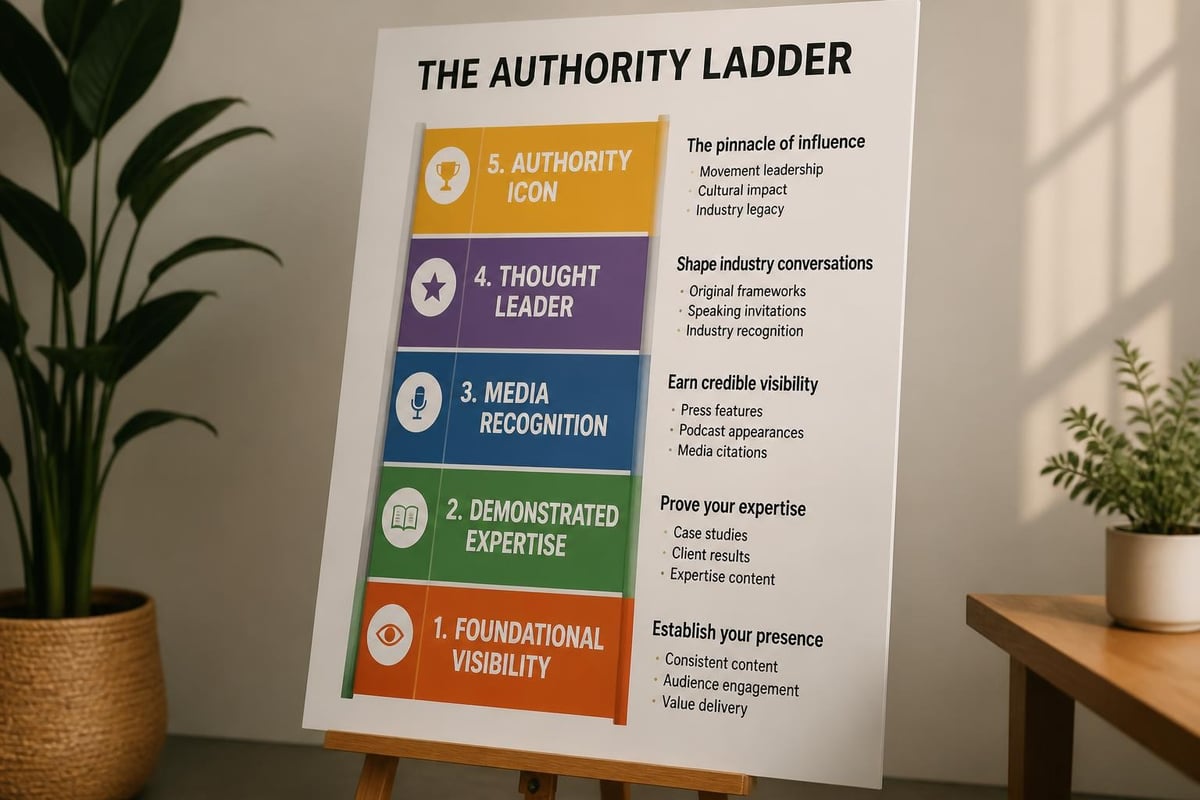
The authority ladder consists of five distinct levels:
- Foundational Visibility – Establishing your presence and basic credentials
- Demonstrated Expertise – Proving your knowledge through tangible results
- Media Recognition – Securing third-party validation through earned media
- Thought Leadership – Shaping industry conversations and frameworks
- Authority Icon – Becoming the definitive voice in your domain
Each level requires specific activities, assets, and strategic positioning. Most professionals plateau at rung two or three, never understanding why their expertise doesn't translate into premium positioning.
Rung One: Foundational Visibility
This entry level focuses on establishing your professional presence and basic credibility markers. Without these fundamentals, higher-level opportunities remain out of reach.
Essential Components
- Professional website with clear expertise positioning
- Consistent social media presence on relevant platforms
- Basic content demonstrating subject matter knowledge
- Published credentials, certifications, or relevant experience
Your goal at this stage is simple: When someone searches your name or expertise area, they find coherent evidence that you exist and possess relevant knowledge. Many would-be authorities fail here, maintaining fragmented or outdated digital presences that undermine their credibility before conversations begin.
The foundation extends beyond mere presence. You must articulate a clear point of view. Generic expertise doesn't register with audiences drowning in content. Specific positioning-"I help manufacturing CEOs reduce supply chain costs by 30%" rather than "I'm a supply chain consultant"-creates immediate differentiation.
Consider how building authority that Google and AI systems trust requires intentional content frameworks from the start. Search engines and AI platforms increasingly reward coherent expertise signals, making foundational visibility more critical than ever in 2026.
Rung Two: Demonstrated Expertise
Visibility alone doesn't equal authority. Rung two requires proof of impact through documented results, case studies, client testimonials, and measurable outcomes.
| Proof Type | Example | Authority Signal |
|---|---|---|
| Case Studies | Detailed client success stories with metrics | Shows methodology and results |
| Client Testimonials | Video or written endorsements | Third-party validation |
| Published Research | Original data or industry studies | Thought investment |
| Speaking Engagements | Conference presentations or workshops | Peer recognition |
Moving from foundational visibility to demonstrated expertise separates hobbyists from professionals. This rung answers the critical question every potential client asks: "Can you actually deliver results, or just talk about them?"
Many professionals struggle here because demonstrating expertise requires documentation discipline. If you're improving your articulation and communication skills, you're building one component of demonstrated expertise-but you must also capture and showcase the outcomes your expertise produces.
Creating Proof Assets
Begin systematically documenting every client win, project milestone, and measurable outcome. Transform these raw results into compelling narratives that potential clients can relate to their own challenges. Generic claims ("I help businesses grow") pale against specific evidence ("I helped a SaaS company increase qualified leads 340% in 90 days through targeted positioning").
The authority ladder demands progression beyond self-reported success. Third-party validation becomes essential, which naturally leads to the next critical rung.
Rung Three: Media Recognition
Media appearances represent external validation that fundamentally shifts market perception. When journalists, producers, or podcast hosts select you as a source, they stake their credibility on your expertise.
This rung transforms how prospects perceive you. The psychological weight of media recognition-particularly television-creates an authority shortcut in audiences' minds. "As seen on NBC" or "featured in Industry Weekly" triggers immediate credibility assumptions that years of self-promotion cannot replicate.
Strategic Media Positioning
Securing meaningful media opportunities requires understanding producer psychology and outlet needs. Media professionals seek experts who:
- Deliver clear, quotable insights without jargon
- Bring fresh perspectives beyond generic advice
- Communicate confidently on camera or in interviews
- Provide value to the outlet's specific audience
For executives and authors, understanding how to overcome the fear that public speaking is scary becomes critical at this stage. Media opportunities multiply for those who can deliver polished, confident performances under pressure.
The evolution of E-E-A-T signals that Google evaluates makes media recognition increasingly valuable beyond human audiences. Search algorithms recognize authoritative external mentions, boosting your digital visibility when you climb this rung.

Building Media Momentum
Media recognition compounds. Your first appearance proves you can deliver, making the second easier to secure. By appearance ten, producers begin seeking you out. This momentum transforms media from an occasional win into a systematic authority-building channel.
However, many experts approach media reactively, waiting for opportunities rather than strategically positioning for them. The authority ladder requires proactive media strategy-identifying target outlets, crafting producer-ready angles, and maintaining consistent outreach.
Rung Four: Thought Leadership
Thought leadership represents a fundamental shift from responding to industry conversations to initiating and shaping them. At this level, you're no longer simply an expert applying established knowledge-you're advancing the field itself.
Thought Leadership Markers
True thought leadership involves:
- Original frameworks – Creating new models or methodologies
- Contrarian insights – Challenging industry assumptions with evidence
- Predictive analysis – Identifying emerging trends before they become obvious
- Educational initiatives – Teaching other experts through courses, books, or programs
This rung demands intellectual investment beyond client work. You must dedicate time to research, synthesis, and content creation that advances collective industry knowledge. Many successful practitioners never reach this level because they remain focused exclusively on service delivery.
For leaders navigating this transition, developing public speaking skills specifically for leadership contexts becomes essential. Thought leadership often manifests through keynote presentations, industry panels, and high-profile speaking opportunities where you shape how audiences think about critical issues.
The concepts behind authority content marketing become particularly relevant here-you're creating content that establishes standards and frameworks others reference.
Moving Beyond Expertise to Innovation
| Traditional Expert | Thought Leader |
|---|---|
| Applies best practices | Defines best practices |
| Shares case studies | Publishes research |
| Speaks at conferences | Keynotes major events |
| Answers questions | Frames questions |
| Follows trends | Predicts trends |
The authority ladder progression from demonstrated expertise to thought leadership requires deliberate positioning. You must identify gaps in industry knowledge, develop original perspectives, and communicate them through high-authority channels.
Rung Five: Authority Icon Status
The pinnacle of the authority ladder represents category dominance-becoming synonymous with your expertise area. When people think of your domain, your name surfaces automatically.
Authority icons don't compete on price or convenience. They command premium positioning because they've transcended expert status to become definitive sources. This level brings opportunities that don't exist at lower rungs: board positions, advisory roles, acquisition offers, and partnership proposals.
Characteristics of Authority Icons
These individuals share common attributes:
- Ubiquity – Consistent presence across multiple high-authority platforms
- Original IP – Frameworks, methodologies, or models bearing their name
- Media ownership – Their own shows, publications, or content platforms
- Selective availability – They choose opportunities rather than chasing them
- Premium pricing – Fees reflecting irreplaceable positioning
Few reach this level, not because they lack expertise, but because they don't understand the systematic progression required. The authority ladder shows that icon status builds methodically through the previous four rungs.

Maintaining Authority Icon Position
Reaching the top rung doesn't guarantee permanent residence. Authority icons continuously reinvest in their positioning through new research, evolving frameworks, and strategic visibility. They understand that authority decays without maintenance.
The investment extends beyond personal brand. Many authority icons build institutions-training programs, certification systems, or industry associations-that formalize their methodologies and extend their influence beyond individual capacity.
Strategic Climbing: Accelerating Your Ascent
Understanding the authority ladder framework is valuable. Strategically climbing it requires specific tactics at each stage.
Acceleration Strategies
For Rung One to Two:
- Document every client result systematically
- Create detailed case studies with measurable outcomes
- Gather video testimonials during peak client satisfaction
- Publish your methodology through articles or guides
For Rung Two to Three:
- Identify target media outlets aligned with your expertise
- Develop producer-ready story angles addressing current issues
- Build relationships with journalists covering your industry
- Invest in media training to ensure polished delivery
For Rung Three to Four:
- Commit to original research or data collection
- Challenge conventional wisdom with evidence-based alternatives
- Create visual frameworks that simplify complex concepts
- Launch your own content platform or publication
For Rung Four to Five:
- Build institutional assets beyond personal brand
- Become highly selective about opportunities
- Develop succession or scaling systems
- Focus on category-defining initiatives
Many professionals attempt to skip rungs, pursuing media recognition before establishing demonstrated expertise or claiming thought leadership without media validation. The authority ladder resists shortcuts. Each level builds credibility markers that make the next accessible.
Common Authority Ladder Mistakes
Even experts aware of this framework make predictable errors that stall their progress.
Plateau Patterns
The Visibility Trap – Creating endless content without upgrading its authority signals. Posting daily on social media maintains rung one but doesn't advance you to rung two without documented results.
The Proof Paradox – Accumulating case studies and testimonials without seeking external validation. You remain at rung two, talking to yourself rather than having others talk about you.
The Media Mirage – Securing isolated media appearances without building demonstrated expertise underneath. When the interview airs, viewers find insufficient proof to justify engagement.
The Innovation Island – Developing brilliant frameworks without media amplification. Thought leadership requires distribution. Original ideas without strategic visibility don't register in marketplace consciousness.
Understanding how to build authority through content with transparent sourcing and expert contributions helps avoid these patterns. Authority building demands integration across multiple channels and proof types.
Recovery Strategies
Identify your current rung honestly. Most professionals overestimate their position by one or two levels. Once you've accurately assessed your standing, focus exclusively on activities that advance you to the next rung rather than maintaining your current level.
If you're stuck at rung two with extensive case studies but no media recognition, stop creating more case studies. Instead, invest that time in media outreach and positioning. The authority ladder rewards strategic focus over scattered effort.
The 2026 Authority Landscape
The authority ladder framework remains constant, but the tactics for climbing each rung evolve with technological and market changes.
AI platforms and search engines now evaluate authority through sophisticated signals that extend beyond traditional metrics. Building authority that both Google and AI systems trust requires understanding how these systems assess expertise markers at each ladder rung.
Current Authority Signals
| Signal Category | Evaluation Method | Ladder Impact |
|---|---|---|
| Content Depth | Comprehensive topic coverage | Rungs 1-2 |
| External Validation | Backlinks and media mentions | Rungs 3-4 |
| Audience Engagement | Comments, shares, discussion quality | Rungs 2-3 |
| Original Research | Unique data or insights | Rungs 4-5 |
| Subject Consistency | Sustained expertise focus | All rungs |
The proliferation of AI-generated content in 2026 makes genuine expertise and third-party validation more valuable than ever. The authority ladder's emphasis on external recognition and media validation provides clear differentiation from synthetic content.
Experts who understand this landscape integrate traditional authority-building (media appearances, speaking engagements, published books) with digital signals (structured content, authoritative backlinks, consistent expertise demonstration) to accelerate their climb.
Your Authority Ladder Assessment
Determining your current position requires honest evaluation across multiple dimensions.
Rung One Indicators:
You have basic online presence, but search results for your name show incomplete or inconsistent information. Media outlets haven't approached you. Your expertise positioning remains broad or generic.
Rung Two Indicators:
You've documented multiple client successes with measurable outcomes. Testimonials and case studies demonstrate capability. However, external parties haven't validated your expertise through media coverage or speaking invitations.
Rung Three Indicators:
You've secured media appearances or speaking opportunities based on your expertise. Third parties reference your work. However, you're responding to existing conversations rather than initiating new ones.
Rung Four Indicators:
You've created original frameworks, methodologies, or research that others reference. Industry peers cite your work. You receive regular invitations to share perspectives on emerging trends.
Rung Five Indicators:
You're the default reference for your expertise area. Opportunities seek you. You own media platforms. Premium clients engage you for access to irreplaceable expertise.
Most professionals operate between rungs two and three-they've proven capability but haven't secured consistent external validation. This represents the most critical gap in the authority ladder, where strategic media positioning creates exponential returns.
For professionals recognizing that public speaking may not be their natural forte, this assessment provides clarity about which skills require development to advance. The authority ladder demands different capabilities at each level, and identifying gaps enables focused improvement.
Integrating the Authority Ladder into Your Strategy
Theoretical frameworks provide limited value without practical application. Integrating the authority ladder into your business strategy requires systematic planning and resource allocation.
Quarterly Authority Audits
Every quarter, assess your position across all five rungs:
- Document current standing – What evidence supports your position at each rung?
- Identify gaps – What's missing to advance to the next level?
- Prioritize activities – Which investments offer the highest authority return?
- Measure progress – What specific milestones indicate upward movement?
This regular assessment prevents the common mistake of random authority activities that don't systematically advance your position. Many experts create content sporadically, pursue occasional media opportunities, and wonder why their authority doesn't compound.
The authority ladder shows that strategic sequencing matters. A CEO investing in a television interview before establishing demonstrated expertise wastes opportunity. The same interview after building comprehensive proof assets converts visibility into business results.
Resource Allocation
Authority building requires investment-time, capital, or both. The ladder framework guides optimal allocation.
Early-stage experts (rungs one and two) benefit most from proof-asset creation: case study development, testimonial collection, and foundational content. Media investment at this stage often underperforms because insufficient proof exists to convert visibility into engagement.
Mid-stage experts (rungs two and three) generate maximum return from media positioning and strategic visibility. Their proof foundation exists; they need external validation to reach broader audiences.
Advanced experts (rungs four and five) benefit from intellectual investment: research initiatives, framework development, and institutional building. Their challenge isn't visibility but category definition.
Understanding where you stand determines whether you should invest in better case studies, guaranteed media placement systems, or original research initiatives.
The authority ladder provides a clear roadmap from unknown expert to industry icon through five progressive rungs: foundational visibility, demonstrated expertise, media recognition, thought leadership, and authority icon status. Each level requires specific proof assets and strategic positioning, with media validation serving as the critical accelerator between mid-tier expertise and recognized authority. As the creator of the BookedForTV™ Guaranteed Placement System and host of Amazing Authorities on NBC Las Vegas, Mitch Carson specializes in helping CEOs, founders, and authors climb the authority ladder through guaranteed TV interviews, producer-ready positioning, and strategic media visibility that transforms expertise into unignorable authority.